Random Animal Generator logo

Panthera leo

Lion Facts

Lions are large social cats best known for their prides, deep roars, manes, and cooperative hunting. They live mainly in sub-Saharan Africa, with a small wild population in western India, and their daily lives are shaped by territory, family bonds, body size, and the search for large prey.

Lion

Scientific name

Panthera leo

Animal group

Mammal

Diet

Carnivore

Habitat

Savannas, grasslands, woodlands, scrub, and some dry habitats

Conservation status

Vulnerable globally; Panthera leo leo is assessed as Endangered

Range

Mostly sub-Saharan Africa, plus an isolated population in western India

Adult weight

Females about 270-400 lb; males about 330-570 lb

Average lifespan

About 17 years on average

Gestation

About 3.5 to 4 months

Key facts

11 Interesting Lion Facts

Behavior

Lions are the most social big cats.

Most cat species are solitary, but lions routinely form prides made of related females, their cubs, and a few adult males. This social system supports group hunting, shared cub protection, and territory defense.

Behavior

A lion pride is usually built around related females.

Female lions in a pride are often mothers, sisters, cousins, and daughters. Older females may remain together for life, while adult males typically move between prides over time.

Anatomy

A male lion's mane is a visual signal as well as protection.

The mane can make a male look larger to rivals and more noticeable to females. It may also help protect the neck during fights over territory or breeding access.

Behavior

Lions can rest for most of the day.

Lions often alternate short periods of activity with long resting bouts. San Diego Zoo notes that lions may spend up to 21 hours in a day lying down, sleeping, or resting.

Diet

Lionesses often cooperate when hunting.

During group hunts, smaller and faster females may chase prey while heavier females ambush or capture it. The roles can change depending on the prey and which females are hunting.

Behavior

Lions use roaring as part of territory communication.

Roaring helps lions announce their presence and coordinate with other pride members. Scent marking, rubbing, and ground scraping also help define territory.

Conservation

Lions now occupy only a small part of their historic range.

In 2025, the lion's current wild range was estimated at just over 6 percent of its historical range. Their remaining populations are often fragmented and isolated.

Record

Lions rely on short bursts of speed, not long chases.

A lion can sprint fast for short distances, but it is not built for long pursuit. Successful hunts depend on cover, timing, cooperation, and getting close enough before the final rush.

Anatomy

Lion cubs can have spots that fade as they grow.

Young lions may show spotting on their coats. These markings usually become less obvious with age as the adult tawny coat develops.

Conservation

Wild Asiatic lions survive in one isolated Indian population.

Wild Asiatic lions are now restricted to India, where they survive in and around the Gir Forest National Park and Wildlife Sanctuary.

Behavior

Male lions do more than display a mane.

Adult males often patrol, scent mark, and defend the pride's territory. They may hunt less often than females, but territory defense can be crucial for cub survival and pride stability.

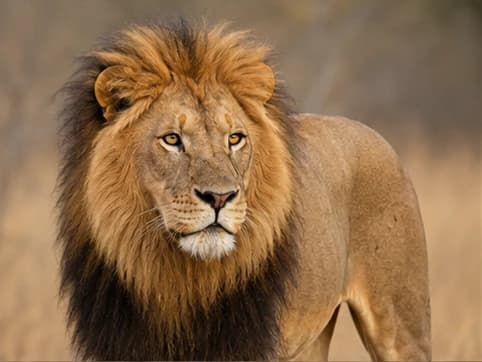
What is a lion?

A lion is a big cat in the genus Panthera and one of the most recognizable predators on Earth. Lions are the most social of the big cats, living in groups called prides rather than spending nearly all of adult life alone.

Most wild lions live in Africa. A small Asian population survives in and around the Gir landscape of western India, making the species both iconic and geographically limited compared with its historic range.

Appearance

Lions have short tawny coats, powerful bodies, rounded ears, and a dark tuft at the end of the tail. Adult males often grow a mane, though mane size and color vary by age, genetics, condition, and environment.

Male lions are generally larger than females. Adult females weigh about 270 to 400 pounds (122 to 180 kilograms), while adult males weigh about 330 to 570 pounds (150 to 260 kilograms). The mane can make a male look more imposing and can offer some protection during fights with rival males.

Habitat and range

Lions use open woodlands, grasslands, savannas, brushy areas, and some dry habitats where prey is available. Cover matters because hunting often depends on getting close before a short burst of speed.

Their modern range is much smaller than it once was. In 2025, the lion's current wild range was estimated at a little over 6 percent of its historical range, with many populations split across protected areas and nearby landscapes.

Diet and hunting

Lions are carnivores that mostly hunt medium to large hoofed mammals. They also scavenge when opportunities appear, which is normal predator behavior rather than laziness.

Lionesses often cooperate during hunts, with different individuals taking chasing or ambush roles. Hunting as a group can improve success and reduce individual risk.

Pride behavior

A pride usually includes related females, their cubs, and a small number of adult males. Female relatives often remain together for life, while males may hold pride residency for shorter periods.

Lions communicate with scent marks, body rubbing, facial expressions, vocal sounds, and roaring. Roars help advertise presence and territory over long distances.

Cubs and reproduction

Lion cubs are usually born in small litters after a gestation of roughly three and a half to four months. They depend heavily on their mothers and the pride, and cub survival can be difficult when food is scarce or when new males take over a pride.

Shared care among related females is one reason pride life is so important. Cubs nurse for months, begin eating meat while still young, and grow up around play, grooming, and social learning.

Size, lifespan, and adaptations

Lions are built for strength and short bursts of speed rather than long-distance pursuit. Their muscular shoulders, powerful forelimbs, camouflage-colored coats, and coordinated hunting behavior all help them tackle large prey.

Lions live about 17 years on average. Asiatic lions are still Panthera leo, but they often have a smaller, shorter mane and a more visible belly fold than many African lions.

Conservation

Lions are globally listed as Vulnerable, and some groups face greater danger. The northern lion group, Panthera leo leo, is assessed as Endangered, with continuing pressure from habitat loss, prey decline, bushmeat poaching, snares, poisoning, and conflict with people.

Protecting lions usually means protecting whole landscapes, prey populations, and local communities that share space with large predators. Conservation is strongest when it pairs protected habitat with practical coexistence work around livestock and local livelihoods.

Keep exploring

Generate or Draw the Lion

Move from reading facts to picking a fresh species, building a sketch ticket, or browsing a themed generator.

Lion FAQ

Where do lions live?

Most wild lions live in sub-Saharan Africa. A small population also lives in western India, where Asiatic lions survive in and around the Gir Forest landscape.

What do lions eat?

Lions are carnivores. They mainly eat medium to large hoofed mammals such as antelope, zebra, wildebeest, and buffalo, and they may scavenge when food is available.

Why do male lions have manes?

A mane can make a male look larger and more impressive, and it may help protect the neck during fights with other males.

Are lions endangered?

Lions are globally listed as Vulnerable. Some groups, including Panthera leo leo, face higher risk and are assessed as Endangered. Habitat loss, prey decline, snares, poisoning, and conflict with people are major pressures.

How big are lions?

Adult female lions weigh about 270 to 400 pounds, while adult males weigh about 330 to 570 pounds. Males are usually longer and heavier than females.

How long do lions live?

Lions live about 17 years on average, though lifespan varies by sex, habitat, food, injuries, conflict, and whether the animal is wild or in human care.

What is the difference between African and Asiatic lions?

Both are lions, Panthera leo, but Asiatic lions are restricted to western India. They tend to have a smaller, shorter mane and a more visible belly fold.

Sources