
Record
The emperor penguin is the largest living penguin species.
Adults stand about 110 to 130 centimeters tall and can weigh up to about 40 kilograms at the start of the breeding season, making them larger than other living penguins.
Aptenodytes forsteri
The emperor penguin is the largest living penguin and one of the most extreme bird species on Earth. It survives Antarctic winter, breeds on sea ice, dives deep into the Southern Ocean, and uses social huddling plus specialized anatomy to conserve heat.
Scientific name
Aptenodytes forsteri
Animal group
Bird
Habitat
Antarctic sea ice and Southern Ocean waters
Diet
Mostly fish, plus squid and krill
Size
About 110-130 cm tall; up to about 40 kg before breeding
Typical lifespan
Most wild birds live less than 40 years
Conservation status
Endangered on the IUCN Red List
Key facts
Record
Adults stand about 110 to 130 centimeters tall and can weigh up to about 40 kilograms at the start of the breeding season, making them larger than other living penguins.
Reproduction
They are famous for breeding in some of the harshest weather on Earth. This unusual timing requires strong cold adaptations and coordinated parental care.
Reproduction
After the female lays a single egg, the male balances it on his feet beneath a brood pouch and fasts while keeping the egg warm through winter.
Record
Most foraging dives are far shallower than the record, but emperor penguins often dive between about 150 and 250 meters, and the deepest recorded dive reached 565 meters.
Record
Most dives are much shorter, often a few minutes, but this record shows how well adapted emperor penguins are for underwater foraging.
Adaptation
Huddling reduces heat loss in extreme cold. Birds rotate through the huddle so individuals are not stuck on the cold outer edge all the time.
Adaptation
Arteries and veins lie close together so blood going to the feet, wings, and bill is cooled, while returning blood is warmed before it reaches the body core.
Habitat
Fast ice is sea ice attached to land, islands, or grounded icebergs. Stable breeding ice matters because egg incubation and chick rearing take time.
Diet
Their diet changes with season and food availability. Fish are often important, with squid and krill adding variety in the Southern Ocean food web.
Behavior
Their survival depends on huddling, so defending spaced-out territories would work against one of their most important cold-weather behaviors.
Conservation
Emperor penguins are listed as Endangered because climate change is reducing the stable sea ice they need for breeding, chick survival, feeding, and moulting.
The emperor penguin is a flightless seabird that lives in Antarctica and the Southern Ocean. It is the largest of the living penguin species and is closely related to the king penguin.
Its life cycle is strongly tied to sea ice. Adults breed in colonies around Antarctica and forage in cold ocean waters where fish, squid, and krill are available.
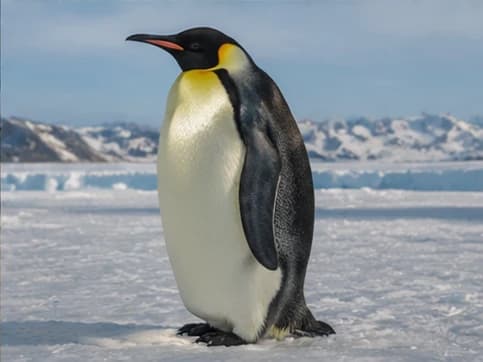
Emperor penguins have black backs, white bellies, and yellow-orange markings around the neck and head. Their dense feather layers, body fat, and compact shape help them survive severe cold.
They are much larger than most penguins, standing about 110 to 130 centimeters tall. Adults can weigh up to about 40 kilograms at the beginning of the breeding season.
Emperor penguins breed in colonies around the Antarctic continent. Many colonies are on fast ice, which is sea ice attached to land, islands, or grounded icebergs.
Adults travel between breeding colonies and the ocean, where they dive for food. Stable sea ice is important because breeding takes months.
Emperor penguins eat mostly fish, with squid and krill also in the diet. They are powerful divers that often forage between about 150 and 250 meters deep.
Their deepest recorded dive is 565 meters, and the longest recorded dive is 22 minutes.
In winter, emperor penguins huddle together to reduce heat loss. Individuals shift through the group so birds take turns in warmer and colder positions.
This huddling behavior is one reason the species can breed in conditions that would overwhelm most birds.
Emperor penguins are famous for breeding during the Antarctic winter. The female lays one egg, and the male incubates it on his feet under a warm brood pouch while fasting.
After the chick hatches, both parents take turns caring for the chick and foraging at sea.
Emperor penguins have dense scale-like feathers, body fat, small bills and flippers relative to body size, and heat-exchange systems that reduce heat loss from feet, wings, and bill.
Their nasal chambers also recover heat that would otherwise be lost during breathing.
The future of emperor penguins is closely linked to Antarctic sea ice. Emperor penguins are now listed as Endangered, with climate-driven sea ice loss expected to sharply reduce populations over coming decades.
Monitoring colonies, sea ice, and foraging areas helps researchers understand how environmental change may affect this species. Protecting emperor penguins also means protecting the Antarctic food web that supports their prey and predators.
Keep exploring
Move from reading facts to picking a fresh species, building a sketch ticket, or browsing a themed generator.
Random Animal Generator
Generate more animals like the Emperor Penguin for lessons, games, or writing prompts.
Open tool →
Random Animal Generator for Drawing
Turn the Emperor Penguin into a pose, viewpoint, and timed sketch challenge.
Open tool →
Random Sea Animal Generator
Discover more ocean species with the sea animal generator.
Open tool →
Random Bird Generator
Browse more birds with type, region, and habitat filters.
Open tool →
Emperor penguins live in Antarctica and forage in the Southern Ocean. They breed in colonies around the Antarctic continent, often on fast ice.
They mostly eat fish, but they also eat squid and krill. Their exact menu changes by season and location.
They use dense feathers, body fat, compact body parts, heat-exchange blood flow, and social huddling to conserve heat.
Emperor penguins are the largest living penguins, standing about 110 to 130 centimeters tall. Adults can weigh up to about 40 kilograms before the breeding season.
They often forage between about 150 and 250 meters deep, and the deepest recorded emperor penguin dive reached 565 meters.
Yes. Emperor penguins are listed as Endangered because climate change is reducing the sea ice they depend on.
Yes. The male balances the egg on his feet under a brood pouch and fasts while incubating it through the Antarctic winter.
They huddle to reduce heat loss during extreme cold and wind. Birds shift through the huddle so individuals take turns in warmer and colder positions.